Inhibitory Control, Updating, Shifting, and Working Memory Performance suggest Cognitive Phenotypes in Non-human Primates
Abstract
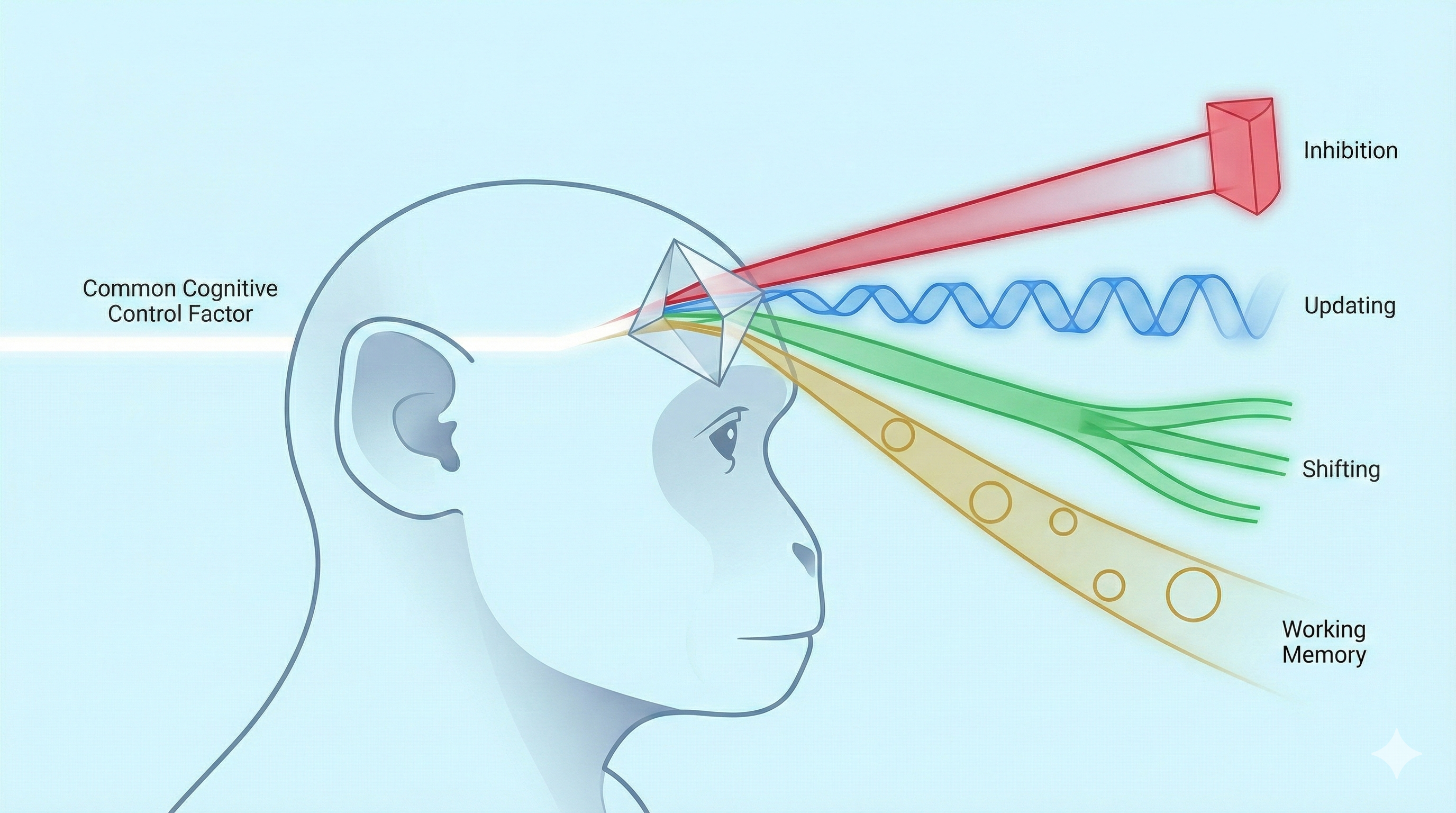
Cognitive control is composed of the four cognitive domains: Inhibitory-Control, Updating, Working Memory, and Set-Shifting. These domains are partially separable in humans, but more unified in children and other subpopulations. How these cognitive domains separate or unify to a common cognitive control factor in nonhuman primates (NHPs) is unknown.
We addressed this question with a multi-task cognitive assay for NHPs that tested all four cognitive control domains. Six monkeys performed four tasks on a touchscreen kiosk over forty experimental sessions:
- An Antisaccade (AS) task measuring Inhibitory-Control.
- A delayed match-to-sample (DMTS) task that varied the delay to measure Working Memory (WM), and the number and perceptual similarity of test objects to measure Inhibitory-Control.
- A continuous updating task requiring subjects to find the novel object among an increasing array of objects to measure WM-Updating and Inhibitory-Control.
- A feature-reward learning task measured Set-Shifting.
We found, first, that NHPs showed robust cognitive control costs within and across sessions. Second, we tested for construct validity of the Inhibitory-Control construct and found positive correlations across metrics quantifying inhibitory control in different tasks. For example, better Antisaccade performance was associated with a reduced spatial congruency effect and with a reduced negative impact of target-distractor similarity in the DMTS task. These results suggest that there is a common cognitive ability to inhibit interfering information.
Third, we tested whether there is a common cognitive control factor that becomes evident in correlations among performance metrics from the Inhibitory-Control, WM-Updating and Set-Shifting domains. After removing subject-specific variances we found a positive correlation structure. Faster Set-Shifting correlated with better Inhibitory-Control in the AS task and the WM task, and with better WM-Updating in the continuous updating task. These correlations were moderate (r’s < 0.5) but were robust against variability between subjects.
In summary, our study documents the versatility to reliably track all three major cognitive control factors with a multi-task assay in NHPs. The Inhibitory-Control factor showed construct validity as it was measurable in different tasks and metrics. Most notably, performance metrics indexing Inhibitory-Control, WM-Updating, and Set-shifting were correlated, consistent with a common cognitive control factor in NHPs. Together, this study characterizes the unity and diversity of cognitive control functions in NHPs.