Planning in Nonhuman Primates Emerges from Structure Knowledge and is Distinct from Attention, Working Memory, Effort Control, and Learning
This work is currently available as a bioRxiv preprint and has not been peer reviewed. Read the full paper: bioRxiv version or PDF.
Abstract
Planning ahead requires mentally simulating future choices before they are needed. This ability may depend on several familiar cognitive operations, including working memory, attention, inhibitory control, effort control, and learning. However, it has remained unclear whether planning is simply the result of combining these abilities or whether it is a distinct cognitive operation.
In this study, six rhesus macaques learned object sequences and then completed those sequences while future objects were hidden from view. Five of the six subjects planned ahead by approximately 2-3 ordinal positions. Planning depth was strongly related to knowledge of the sequence structure, but formed a distinct cognitive factor from sequence memory, object memory, and learning speed. Planning was also separated from working memory capacity, selective attention, inhibitory control, and effort control. These results suggest that nonhuman primates can spontaneously plan future choices using an internal model of sequential structure.
Study Design
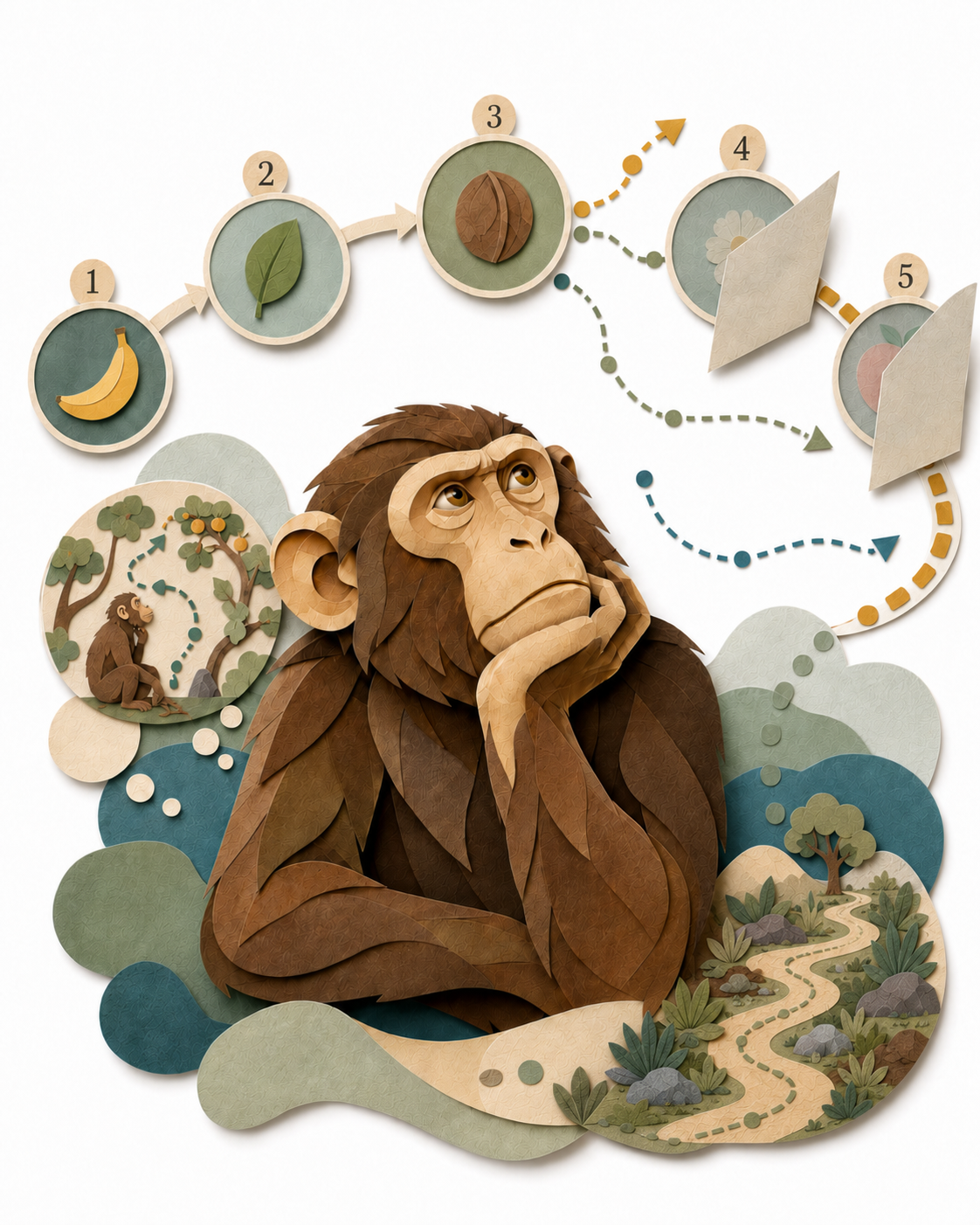
Each subject learned four-object sequences presented together with a fifth, irrelevant distractor object. The four relevant objects had to be selected in a fixed order, such as A-B-C-D, while their screen locations changed from trial to trial. The objects were multidimensional 3D stimuli generated with Quaddle 2.0, which made it possible to test object-based sequence knowledge rather than simple spatial memorization.
Each sequence was tested across 20 trials. During the first five trials, every object was visible. From trial 6 onward, grey masks hid the object at and beyond a randomly selected ordinal position on most trials. The mask could begin after the first, second, or third correct choice. To complete the sequence, subjects therefore had to remember the learned order and select objects that they could no longer see.
The animals also performed separate tasks measuring four other abilities:
- An antisaccade task measured inhibitory control.
- A working memory updating task measured how many objects could be maintained and updated.
- A visual search task measured selective attention and resistance to distractors.
- An effort control task measured willingness to work for larger rewards.
Together, these tasks allowed planning to be compared with several domain-general cognitive and motivational processes.
Main Findings
Subjects planned beyond the first hidden object
The masks made the sequence task more difficult, but they did not prevent the subjects from completing sequences. During the later trials, completion rates remained close to 90% in both masked and unmasked conditions. More importantly, accuracy for masked objects was above forward-looking chance at the first, second, and third positions after mask onset. This pattern shows that subjects were not merely recalling the next object. They were able to prepare multiple future choices before those choices became visible.
The average planning depth was 2.20 items ahead. Five of the six subjects showed reliable forward planning, with individual planning depths generally between about 2 and 3 objects. Bayesian model comparisons supported multi-step planning strategies for the strongest planners, while one subject showed little evidence for planning beyond chance.
Sequence knowledge predicted planning depth
Planning was most strongly related to how well subjects knew the serial structure of the sequence. Subjects that made more consecutive correct choices, completed more error-free trials, and chose objects more efficiently also planned farther ahead. In contrast, simple measures of how quickly subjects learned a sequence, such as the trial of first completion and cumulative learning errors, showed weak or non-significant relationships with planning depth.
Structural path analysis provided a more detailed picture. Item-level memory helped subjects form knowledge of the sequence, and sequence knowledge directly predicted planning. Faster learning did not have a direct effect on planning. This suggests that remembering individual objects is not sufficient: those memories must be organized into an ordered representation before they can support forward planning.
Planning formed its own cognitive factor
An exploratory factor analysis separated the sequence-task measures into three factors:
- Sequence memory quality, explaining 54.0% of the variance.
- Learning speed, explaining 18.3% of the variance.
- Planning, explaining 10.9% of the variance.
Planning depth loaded primarily on the third factor rather than on the factors for memory quality or learning speed. In other words, subjects could be good or poor at learning and remembering a sequence without those abilities completely determining how far ahead they planned.
Planning was distinct from other cognitive abilities
Across the full set of tasks, the analysis identified separate factors for sequence knowledge, visual-search attention, working memory updating, effort control, sequence item memory, and sequence learning speed. Planning grouped with sequence knowledge but was not directly associated with working memory capacity, attentional interference, antisaccade performance, or willingness to exert effort for reward.
Working memory was related to better memory for individual objects and therefore may support planning indirectly by helping subjects build a stronger sequence representation. Once that structure was learned, however, planning depth appeared to reflect a separate operation rather than a simple measure of working memory capacity.
Why This Matters
These findings support the idea that planning can emerge from an internal model of relationships among events. The monkeys did not need to see every object at the moment of choice because they had learned the ordinal structure connecting the objects. That structure allowed them to mentally simulate upcoming choices and map future positions onto the current display.
The results also help clarify why planning may sometimes be associated with memory or executive control without being identical to any of them. Working memory and object memory can help establish the relevant structure, but planning depends on using that structure prospectively. This distinction may be useful for understanding how neural systems represent sequences, future states, and cognitive maps in both nonhuman primates and humans.
The study used six subjects, and the absence of relationships between planning and the other cognitive tasks should therefore be interpreted cautiously. More complex planning tasks or larger samples may reveal additional connections. Nevertheless, the results provide behavioral evidence that forward planning in rhesus macaques is measurable, spontaneous, and not reducible to attention, working memory, inhibitory control, effort control, or learning speed alone.
Reference
Wen, X., Neumann, A., Dhungana, S., Tiesinga, P., & Womelsdorf, T. (2026). Planning in Nonhuman Primates Emerges from Structure Knowledge and is Distinct from Attention, Working Memory, Effort Control, and Learning. bioRxiv. https://doi.org/10.64898/2026.07.17.739240